Petit Gâteau: Asia by Jordi Bordas

Jordi Bordas needs no introduction in the world of contemporary pastry. A Sosa Ingredients ambassador for over five years, his career has been marked by a constant pursuit: creating high-level technical pastry without compromising inclusivity. Now, in his new role as Adamance ambassador, Bordas consolidates a collaboration that transcends brands to build a common language based on raw material quality and conscious innovation.

The Petit Gâteau Asia is born precisely from that shared philosophy. Developed for the Singapore market, this individual dessert represents a perfect synthesis between European technique and Asian flavors, formulated under the pillars that define Bordas’ style: gluten free, lactose free, and with fiber content. This isn’t “free-from” pastry: it’s thoughtful pastry, where each ingredient fulfills a technical and sensory function without compromise.

A Collaboration Between Sosa Ingredients and Adamance

This recipe is the result of a strategic collaboration between two brands that share a vision: Sosa Ingredients, with its expertise in texturizers and technical ingredients, and Adamance, a specialist in fruit purées of controlled origin. Together, they enable the creation of preparations where functionality and flavor coexist without hierarchy.

For the Asian market, where demand for gluten-free and lactose-free pastry is growing exponentially, this type of technical proposal makes the difference between adapting existing recipes and designing coherent sensory experiences from scratch.

Cold Inulin: The Invisible Balance

Among all the Sosa ingredients present in this recipe, Cold Inulin deserves special mention. This soluble fiber, extracted from chicory root, acts as a stabilizer and bulking agent without adding sweetness or modifying the aromatic profile of the preparations.

Its technical function in Petit Gâteau Asia is fundamental: it allows the water balance of the entire ensemble so that it doesn’t lose water during storage. In a dessert where layers with different moisture content coexist —from the dry sablé to the cremeux and mousse— water migration is one of the greatest technical risks. Cold Inulin acts as a regulator, maintaining each texture in its optimal state without generating syneresis or softening of the crispy
layers.

Furthermore, being a fiber, it adds nutritional value to the dessert without compromising its indulgent character. In a market like Singapore, where health and wellness awareness coexists with the search for high-level gastronomic experiences, this type of technical decision makes the difference.
Vibrant yellow: when colour also communicates

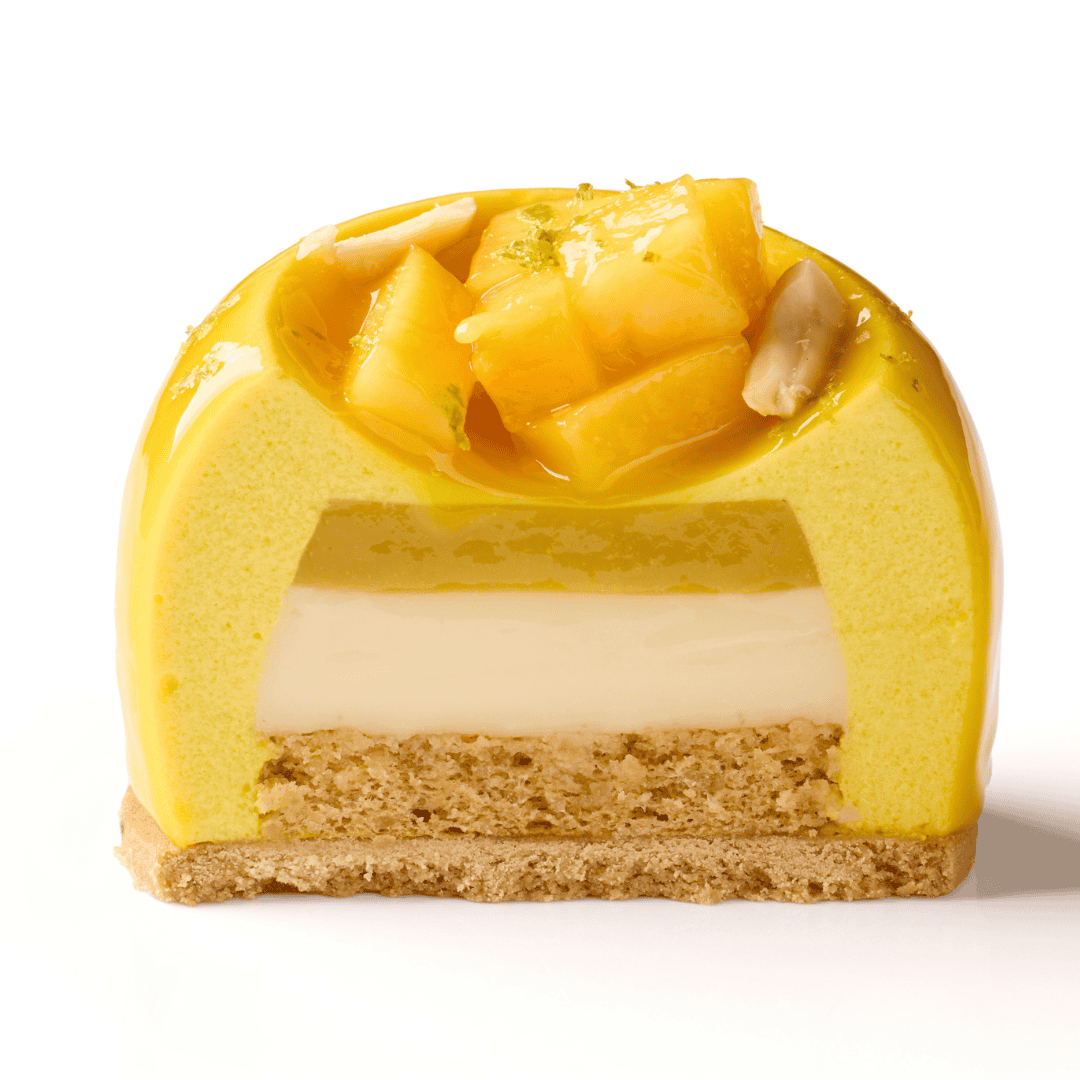
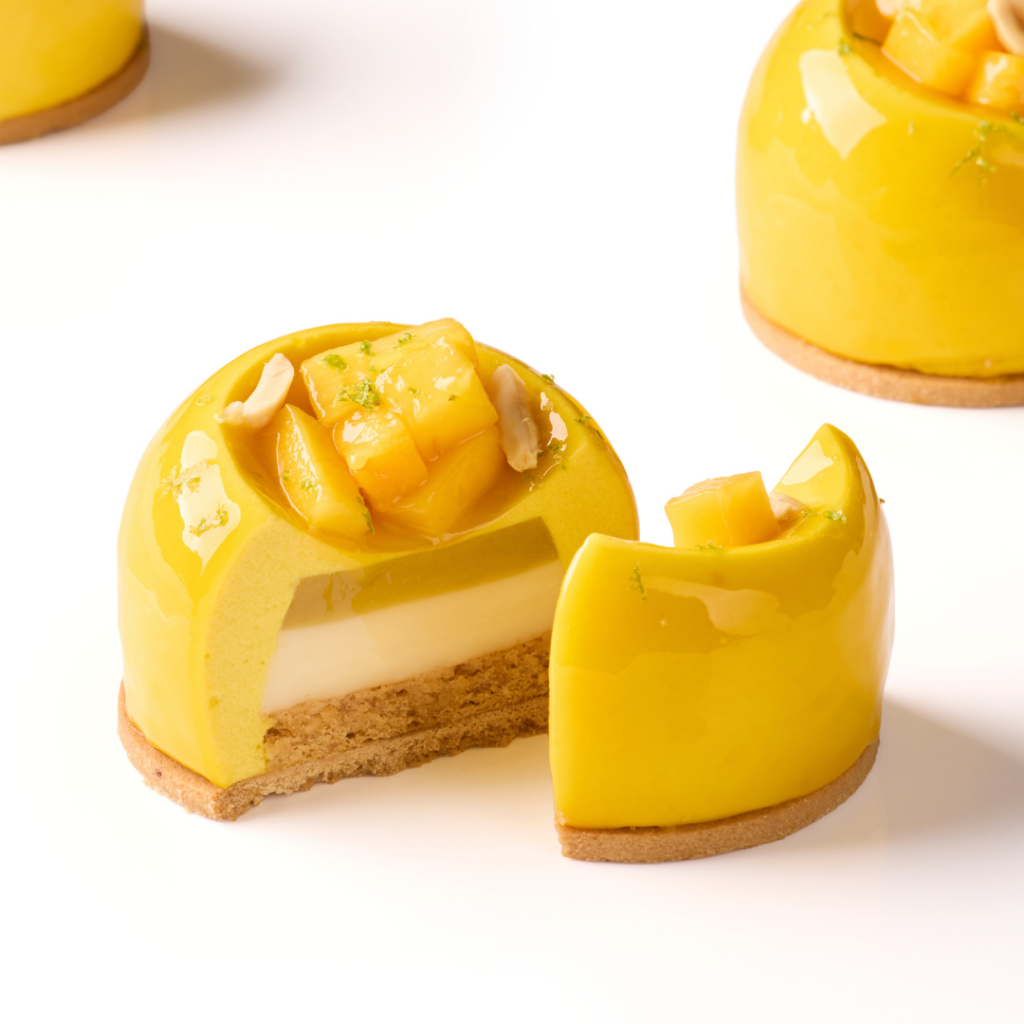
The visual result of the Petit Gâteau Asia is a vibrant, intense yellow that communicates freshness and tropicality even before tasting it. This color is not accidental: it comes from Adamance Alphonso mango, whose natural pigmentation is especially intense.

The finish with fresh mango cubes and lime zest provides a subtle chromatic contrast—green on yellow—and reinforces the citrus-fruity profile of the dessert. This is not decoration: this is sensory coherence. Each visual element anticipates what will happen on the palate.

Petit Gâteau: Asia by Jordi Bordas

Ingredients

Prepared by

  • Peanut Sablée

    1. Mix the water and coconut sugar with a hand blender until the sugar is completely dissolved. Add the coconut fat, peanut paste, and lecithin, and emulsify vigorously with the hand blender for 2 minutes.
    2. Mix the rice flour, flaxseed fiber, baking powder, and salt thoroughly in the stand mixer with the paddle attachment at low speed. Add the previous preparation and mix until a homogeneous texture is achieved.
    3. Roll out the dough between two silicone mats to a thickness of 3 mm and freeze.
    4. Remove the silicone mats, cut 32 discs with the sablée ring, and place on a tray lined with a perforated silicone mat. Bake at 150°C for approximately 14 minutes in a convection oven with the vent open.
    5. Allow to cool to room temperature (20°C) and brush both sides of the discs with melted coconut oil. Store in a dry place or freeze.
  • Peanut Sponge Cake

    1. On a tray lined with a silicone mat, place the sponge cake bars, leaving a 30 cm wide space between them.
    2. Toast the peanuts at 140°C for approximately 20 minutes in a convection oven with the vent open. Allow to cool.
    3. Whip the egg whites 1, Albuwhip, and cream of tartar in a temperature-controlled mixer for 4 minutes at medium-high speed. Add the coconut sugar 1 and whip for another 6 minutes until a light meringue forms, maintaining a temperature of approximately 30°C throughout the process.
    4. Mix the toasted peanuts and rice flour in a food processor until a fine powder is obtained.
    5. Mix the egg whites 2, egg yolks, peanut paste, and coconut sugar 2, and emulsify vigorously with a hand blender for 2 minutes. Stir in one-third of the powder mixture and blend with the hand blender.
    6. When the meringue is ready, fold in the previous preparation and the remaining powder mixture, mixing gently with a spatula.
    7. Pour the batter between the bars, smooth the surface, and remove the bars. Spray with water and bake at 150°C for approximately 7 minutes in a convection oven with the vent closed.
    8. Allow to cool and remove the sponge cake from the silicone mat. Cut 32 discs with the sponge cake ring and freeze.
  • Calamansi Gelée

    1. Mix the sugar, inulin, pectin, and guar gum.
    2. Heat the water to 30°C in a saucepan and stir in the sugar mixture. Heat to 45°C, stir in the purée, and heat to 85°C, stirring constantly.
    3. Pour 10 g of gelée into the molds and freeze.
  • Calamansi Cremoso

    1. Heat the water to 30°C in a saucepan and stir in the sugar mixture. Heat to 45°C, add the purée, and heat to 85°C, stirring constantly.
    2. Mix the coconut oil, lecithin, and the previous preparation, and emulsify vigorously with a hand blender for 2 minutes.
    3. Store in the refrigerator for at least 4 hours.
    4. Work the cream with a hand blender to homogenize the texture. Fill the molds with 20 g over the gelée, cover with the sponge cake discs, which should remain inside the molds, level, and freeze.
    5. When completely frozen, unmold the inserts and store in the freezer.
  • Mango Mousse

    1. Mix 1/3 of the purée with the gelatin powder and allow to hydrate for 1 hour.
    2. Mix the remaining purée, citric acid, and guar gum with a hand blender and allow to hydrate for 15 minutes.
    3. Heat the gelatin mixture to 45°C, mix with the other purée mixture, coconut oil, and Natur Emul, and emulsify vigorously with a hand blender for 2 minutes.
    4. Mix the egg whites, Albuwhip, cream of tartar, and inulin with a hand blender and whip in a stand mixer for approximately 8 minutes at medium-high speed. Increase to maximum speed and whip for another 2 minutes, maintaining a temperature of approximately 30°C throughout the process.
    5. When the meringue is ready, gradually fold in the previous preparation in the stand mixer at low speed and finish mixing gently by hand.
    6. Place a dot of mousse at the bottom of the outer molds and place the silicone domes inside the molds on the mousse, slightly tilted to one side.
    7. Pipe 30 g of mousse into the outer molds, place the inserts (sponge cake side up), which should be flush with the mold, smooth, and freeze.
  • Mango glaze

    1. Mix the sugar, pectin, and guar gum.
    2. Mix the oligofructose and inulin.
    3. Heat the mango purée and water to 30°C in a saucepan and stir in the sugar mixture. Heat to 45°C, add the oligofructose mixture and lemon purée, and heat to 85°C, stirring constantly.
    4. Allow to cool and store in the refrigerator for at least 4 hours.
  • Final assembly

    1. Place the sablée discs on the bases.
    2. Heat the glaze to 70°C. Unmold the mousse pieces and carefully remove the silicone domes with the help of a knife.
    3. Place the mousse pieces on a rack and spray with the glaze until completely covered. Place the mousse pieces on the sablée discs.
    4. Mix some mango cubes with lime zest and lightly chop some peanuts. Fill the mousse cavities with the mango cubes and chopped peanuts and decorate with lime zest.
    5. Before serving, allow to thaw in the refrigerator for at least 2 hours.

Share this recipe

Other recipes that may interest you

Products
Products