Vegan Dessert Pistachio, Coconut, and Blackcurrant

During 2023, together with Jordi Bordas, we presented the Manual of Fibers for Pastry. A year that was definitely a turning point. Not only because of the technical approach, but because it consolidated a line of work that Jordi has been advocating for years: a pastry more balanced in sugar, more intense in flavor, and capable of responding to current needs, including 100% vegan pastry.

Within that manual we launched this recipe: Vegan pistachio, coconut, and blackcurrant individual pastry. It is important to contextualize it because, over time, some creations lose their origin. This recipe was born between 2022 and 2023 as a practical application of fiber-based pastry work.

Fibers: a new technical category in pastry

When we speak about fibers in gastronomy, we refer to a relatively recent categorization of technical ingredients with structural functionality. They are not just nutritional components. They are technological ingredients capable of providing texture, water retention, stability, sugar reduction and sensory improvement.

In this recipe, all structures are built using fibers. This allows us to develop a completely plant-based dessert without eggs, dairy or traditional animal-based gelling agents. At the same time, fibers help modulate sweetness perception, allowing the main ingredient’s flavor to take center stage.

A 100% vegan dessert with clear identity

The goal was not simply to create a vegan dessert. It was to build a 100% vegan dessert where the pistachio flavor is immediate, clean and persistent.

To achieve this, we worked with Pistachio Paste, a high-quality product with a pure aromatic profile and no unwanted interference. When sugar levels are reduced and formulations are balanced with fibers, the quality of the raw material becomes decisive. There is nothing to mask imperfections. Pistachio must taste like pistachio. And in this recipe, it truly does.

Coconut provides plant-based fat and roundness. Cassis introduces acidity and aromatic tension. The combination creates both structural and gustatory balance, where each element fulfills a technical and sensory function.
Technical structure of the recipe

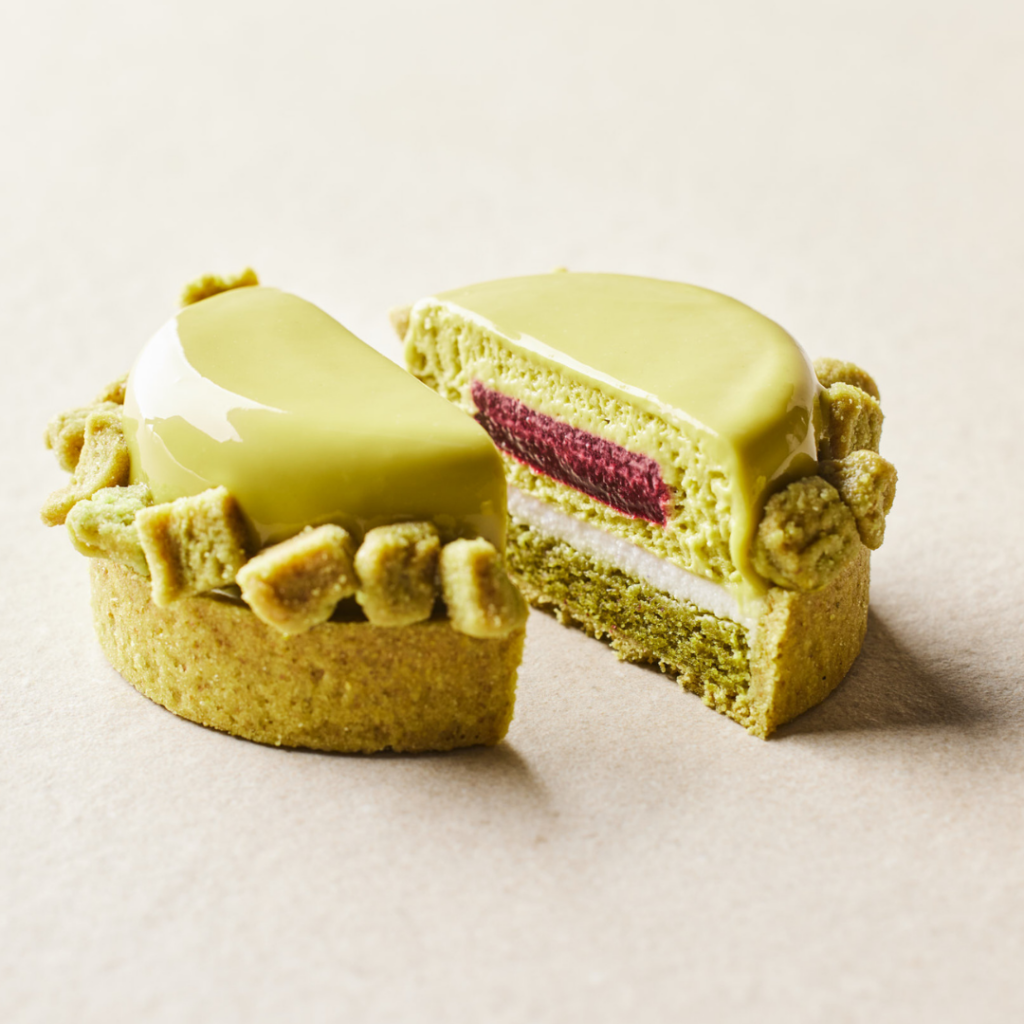
This individual dessert is composed of several preparations layered together: a structural base, a plant-based creamy layer, a fruit component and a final finish.

Fibers allow us to stabilize creams, control viscosity and improve freeze-thaw performance without losing texture. From a technical perspective, this is essential in modern pastry, especially for productions that require consistency and precision.

Furthermore, by reducing simple sugars and relying on fibers, we achieve a more balanced sweetness curve and greater aromatic perception. The result is a more contemporary pastry style: less saturated, more defined.
Vegan Dessert Pistachio, Coconut, and Blackcurrant

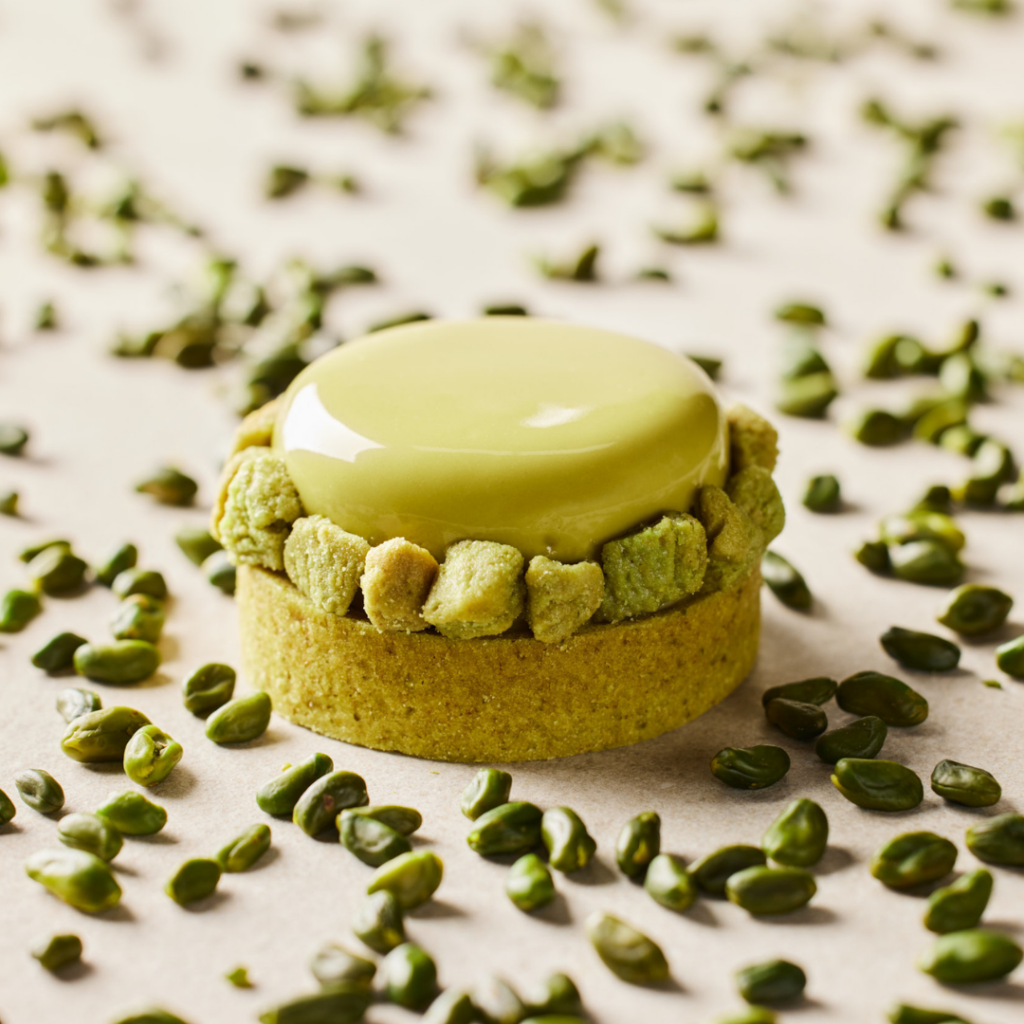
The vegan pistachio, coconut, and blackcurrant individual pastry represents a way of understanding contemporary pastry: rigorous technique, nutritional balance, sugar reduction, and absolute respect for flavor. Recipe for 12 tartlets.

Ingredients

Prepared by

  • Pistachio Financier

    1. Mix the water, pistachio paste, sunflower oil, sugar, salt and Flaxfiber and emulsify thoroughly using a blender for 1 minute.
    2. Mix the rice flour, pistachio flour, food colouring and baking powder and whisk them into the previouspreparation.
  • Pistachio Sablé

    1. Mix the water, sugar, coconut oil, sunflower oil, colouring and Natur Emul and emulsify thoroughly using ablender for 1 minute.
    2. Mix the previous preparation with the rest of the ingredients using a blender with the paddle attachment at lowest speed until it is homogeneous.
  • Coconut Cremeux

    1. Mix the sugar, inulin, and pectin.
    2. Heat the purée to 85°F (30°C) in a saucepan, whisk in the sugar mixture and heat to 185°F (85°C),stirring all the while.
    3. Mix the Flaxfiber and the previous preparation and emulsify thoroughly using a blender for 1 minute.
  • Blackcurrant jelly

    1. Mix the Oligofruct, guar gum, and pectin.
    2. Heat the water and purée to 85°F (30°C) in a saucepan, whisk in the Oligofruct mixture and heat to 185°F(85°C), stirring all the while.
  • Pistachio Mousse

    1. Mix the sugar and Vegan Mousse Gelatine. Heat the water 1 to 85°F (30°C) in a saucepan, whisk in the sugar mixture and heat to 85 °C, stirring all the while.
    2. Mix the pistachio paste, coconut oil, Flaxfiber and the previous preparation and emulsify thoroughly using ablender for 1 minute. Cool to 85-95°F (30-35°C).
    3. Beat the water 2 and Sojawhip for 6 minutes in the mixer at medium-high speed.
    4. Add the Oligofruct and whip for approx. 4 minutes more, until you have a light meringue, keeping the temperature at approx. 85°F (30°C) during the whole process.
  • Pistachio Glaze

    1. Mix Oligofruct, inulin, pectin and coloring.
    2. Heat the water to 85°F (30°C) in a saucepan and whisk in the Oligofruct mixture, then heat to 185°F (85°C), stirring all the while.
    3. Mix the pistachio paste, the Natur Emul, the salt and the previous preparation and emulsify thoroughly using a blender for 1 minute.
  • Vegan pistachio, coconut, and blackcurrant individual pastry

    1. Prepare the financier dough and roll it out between 2 methacrylate rulers of 60cm (depth: 8mm), placed 30cm apart on a tray lined with a silicone mat. Remove the rulers and bake at 250°F (120°C) for 27 minutes in a convection oven with its vent closed. Let it cool, peel off the silicone mat and cut it into 12 discs with a 7cm cutter. Reserve at room temperature (70°F or 20°C).
    2. Prepare the sablée dough, roll out 700 g between 2 silicone mats to a depth of 3mm and freeze. Peel off the silicone mats and cut the sablée dough into 12 discs using a 7cm cutter, as well as some 2cm widestrips. Place twelve 8cm perforated rings (depth: 2cm) on a tray lined with a perforated silicone mat, usethe strips to line the sides and place the discs in the base. Gently squeeze the edges of the bases with yourfingers so that they seal perfectly with the sides, and freeze. Bake at 250°F (120°C) for 40 minutes in aconvection oven with its vent open. Let them cool, freeze them and place a disc of financier in the base ofeach tartlet. Set aside in the refrigerator.
    3. Roll up the remaining sablée, spread the chunks evenly on a baking tray lined with baking paper, using a rack to break them into evenly sized pieces, and bake at 250°F (120°C) for 35 minutes in a convection oven with its vent open. Let them cool, cut them into pieces of approx. 10 x 10mm and mix gently with 60g of melted coconut oil. Reserve at room temperature (70°F or 20°C).
    4. Prepare the crémeux, pour 25g over the financier in each tartlet and freeze.
    5. Prepare the jelly, put 10 g into each one of twelve 4cm silicone molds (depth: 2cm) (SilikoMart modelSF027) and freeze. When the jellies have completely frozen, turn them out and keep them in the freezer.
    6. Prepare the pistachio mousse and use it to half-fill twelve 6.5cm 12 silicone molds (depth: 2.5cm) (SilikoMart model SF333). Insert the jelly discs, finish filling the molds with more mousse, smooth out andfreeze.
    7. Prepare the glaze and leave it to chill in the refrigerator for at least 4 hours.
    8. Heat the glaze to 85°F (30°C). Unmold the mousse discs, glaze them, and place them on the tartlets. Decorate by placing some sablé pieces around the mousse. Arrange them on bases.

Share this recipe

Other recipes that may interest you

Products
Products