
 SOSA
SOSA
Leading international company in the creation and distribution of premium ingredients for gastronomy, pastry and modern cuisine, recognised for its innovation in textures, technique and culinary development.
Every July 30th, the entire world celebrates World Cheesecake Day, a dessert whose origins stretch back to Ancient Greece, where it was already delighting palates long before becoming the star of contemporary patisserie windows and celebrations. The story begins specifically in 776 BC, on the island of Samos, where cheesecake was used to nourish athletes competing in the first Olympic Games, thanks to the protein content of the cheese used to make it.
Centuries later, a New York cheesemaker accidentally added cream cheese to the original recipe in 1872 while attempting to replicate a French cheese variety, obtaining a soft and creamy cheese that he later marketed under the name Philadelphia Cream. And so the modern cheesecake as we know it today was born.
In 2026, cheesecake has transcended the category of dessert to become a global gastronomic phenomenon. Patisseries specializing exclusively in cheesecake are proliferating in major cities around the world, from Tokyo to Madrid, with proposals ranging from the classic New York-style to versions incorporating local ingredients, high-end pastry techniques and, increasingly, lactose-free, gluten-free and vegan alternatives. The 2026 consumer is not just looking for flavor: they seek inclusivity, ingredient transparency and preparations that align with their values and dietary needs without compromising the sensory experience.
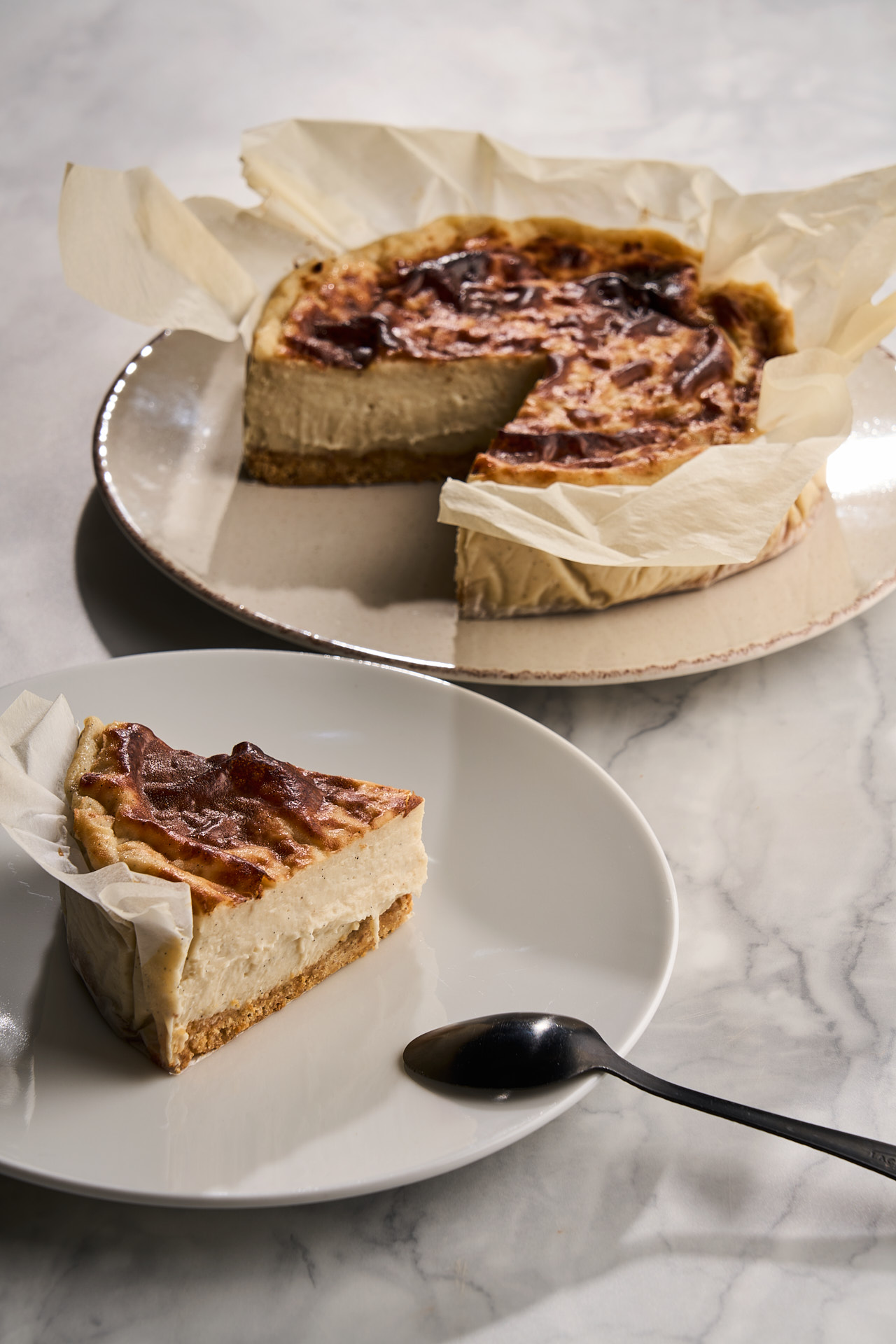
This Vegan and Gluten-Free Basque-Style Cheesecake responds precisely to that demand. It takes the soul of the Basque cheesecake — that creamy, almost liquid center with a dark caramelized surface that sets it apart from all others — and reinterprets it without any animal-derived ingredient and without gluten, proving that technique can overcome any restriction without the result losing an ounce of character.
The Basque cheesecake—known internationally as the Basque Burnt Cheesecake—is perhaps the most disruptive of all cheesecakes. Born in the La Viña restaurant in San Sebastián in the 1990s, it is characterized by being baked at a very high temperature, without a traditional cookie base, and by that burnt surface—almost charred—which in any other context would be a mistake but here is precisely what makes it unique. Its interior is creamy, almost melting, with a texture that oscillates between mousse and custard. A dessert that breaks all the rules of cheesecake and therefore surpasses them all.
Replicating that characteristic texture without conventional cream cheese or egg is one of the most interesting technical challenges in contemporary vegan pastry. And in this recipe, we achieve it.
Preparing the batter for this vegan cheesecake requires precision in the integration of ingredients. To guarantee a homogeneous texture, without lumps and with the characteristic creaminess of Basque cheesecake, the use of a Thermomix is recommended. This kitchen robot allows for temperature control during the mixing process, which is fundamental when working with vegetable fats that need to be at a specific temperature to emulsify correctly. The controlled speed of the Thermomix also avoids excessive air incorporation, which could generate a spongier texture than desired instead of the dense creaminess characteristic of the Basque style.
The substitution of all gluten-containing ingredients has been approached with technical precision, guaranteeing that the cheesecake’s structure holds during baking and that the final result has the same integrity as the conventional version.
Creating a vegan and gluten-free cheesecake that maintains the characteristic texture of the Basque style is no simple task. It requires understanding the role of each conventional ingredient—cream cheese, egg, flour—and finding alternatives that not only fulfill the same technical function but do so while maintaining the balance of flavors.
In vegan pastry, replacing cream cheese is the central challenge. Plant-based alternatives must have a similar fat proportion, a texture that emulsifies correctly, and a neutral flavor profile that does not interfere with the final result. Replacing the egg, for its part, requires working with ingredients that provide both the binding capacity and the structure that the egg provides during baking.
The result is a cheesecake that makes no apologies for being vegan or gluten-free. It is a dessert that stands on its own, with a caramelized surface, a creamy and melt-in-the-mouth interior, and an almond streusel base that provides the perfect contrast.
For the third time this year, Jordi Bordas has created a dessert designed specifically for the Asian market. And he does so, once again, without giving up the promise that already defines this series of recipes: *less sweetness, more fibre, lactose-free and gluten-free. Exotic Forest proves that reformulating doesn’t mean taking away, but rather building […]
“To pay tribute to these countries, we created the Raspberry and Lychee Madeleine XL. An entremet that celebrates one of the most prized fruits of the region: the lychee, a true delicacy for Asian palates” Jordi Bordas The Madeleine XL is not a traditional madeleine. It borrows the iconic shell-like shape — that evocative mold […]
Some chefs cook. Others research while they cook. Saïd M’Dahoma belongs to the second category. Known in the world of contemporary pastry as Pastry Nerd, this pastry chef combines an academic background in neuroscience with a technical and creative sensibility that has positioned him as one of the most compelling voices in today’s gastronomic landscape. […]
 Congelable

 938 666 094
 sosa@sosa.cat