

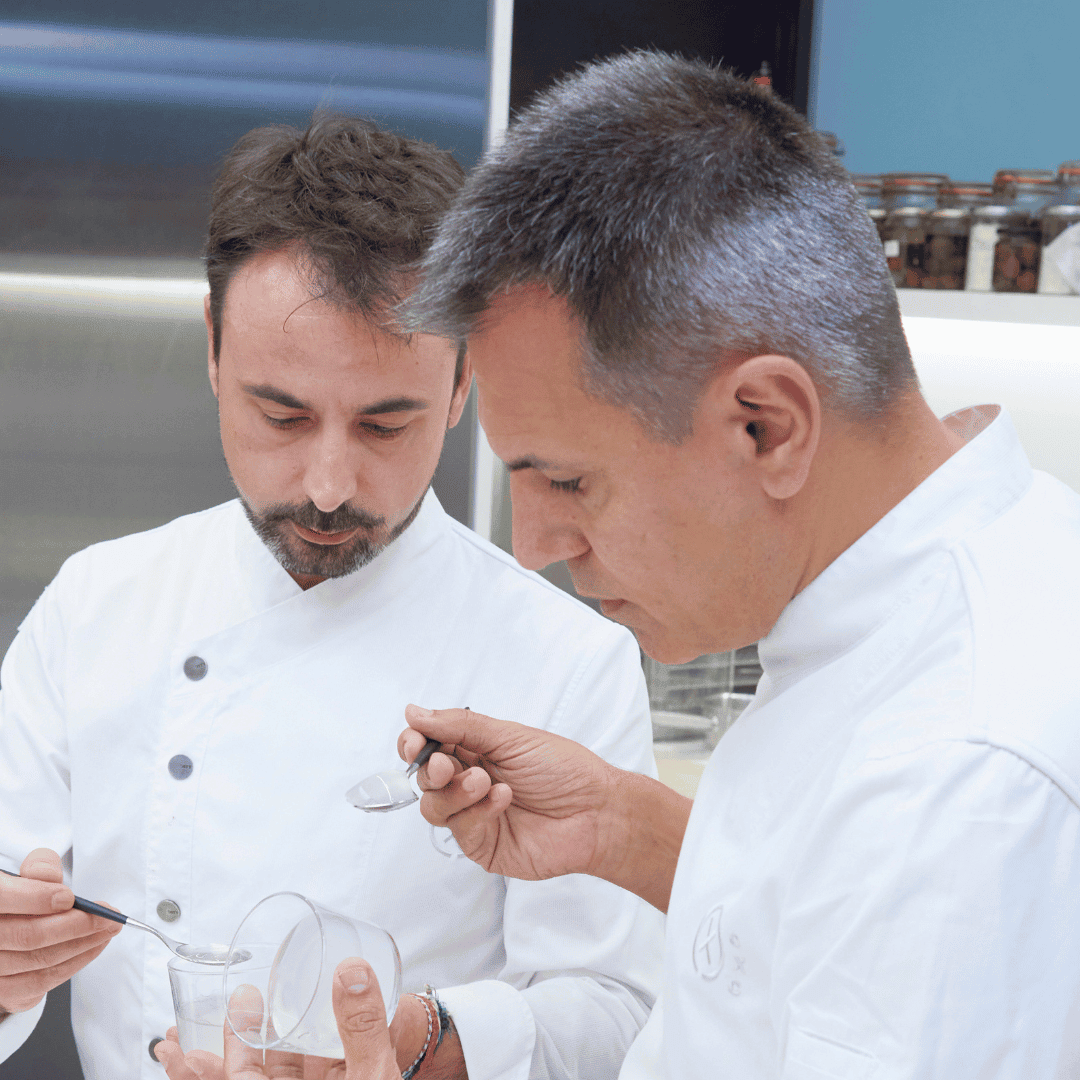
 Disfrutar
Fine dining restaurant in Barcelona, internationally renowned for its creativity, technique and avant-garde approach, considered one of the best in the world. Founded by former members of elBulli, it stands out for its constant innovation and unique gastronomic proposal. It is also an ambassador of Sosa Ingredients.
Mochi is an emblem of Japanese pastry, known for its elastic texture and its characteristic ability to stick to itself. In this recipe, which we have called Lemon Konjac Mochi, we explore a new interpretation using Konjac Gum, a texturizer with thickening capabilities that allows us to obtain a dough with similar properties to the traditional one, but with additional advantages.
The incorporation of Konjac gum in the dough of this mochi guarantees a structure that sticks to itself, imitating the original texture. In addition, its thermo-irreversible nature allows the dough to be worked at high temperatures without losing its properties, which extends its applications beyond pastry.
This recipe has been tested by the team at the prestigious Disfrutar restaurant in Barcelona, recognized with three Michelin stars and famous for its avant-garde approach to gastronomy. In their kitchens, we have found that this dough is extremely versatile and can be used in the preparation of gyozas, mochis, dumplings and other culinary formats.
The Sal Viva by Ángel León is food-grade sodium acetate (E262), the salt obtained from the acetic acid in vinegar. Created by Ángel León and his team at Aponiente and marketed in Europe by Sosa Ingredients, it behaves differently from common salt: when cooled carefully, it remains a supersaturated solution, liquid but ready to crystallize. […]
Plated dessert is probably the most demanding discipline in restaurant pastry. Unlike a display-case preparation, which must hold for hours, a plated dessert is built to be eaten at the exact moment it reaches the table. This makes it possible to work with contrasting temperatures, fleeting textures and preparations that would not survive in a […]
Smoking is one of the oldest techniques in cooking and, at the same time, one of the most difficult to integrate into professional service. It requires specific equipment, time, space, and precise control of the process. In a catering context where operational efficiency is as critical as the result on the plate, this technical barrier […]



 938 666 094
 sosa@sosa.cat