
 Javier Sánchez
Chef and gastronomic content creator specializing in contemporary fusion cuisine, with over 12 years of experience in Barcelona. Noted for his creative combinations and aesthetic attention to plating, he is a member of Gronda, where he has a wide reach and thousands of followers.
Few dishes are as deeply rooted in Spanish bar culture as ensaladilla: potato, mayonnaise, tuna or shrimp, an olive on top. A classic everyone knows, everyone has eaten—and precisely for that reason, one of the hardest to reinterpret without the diner feeling that something has been taken away.
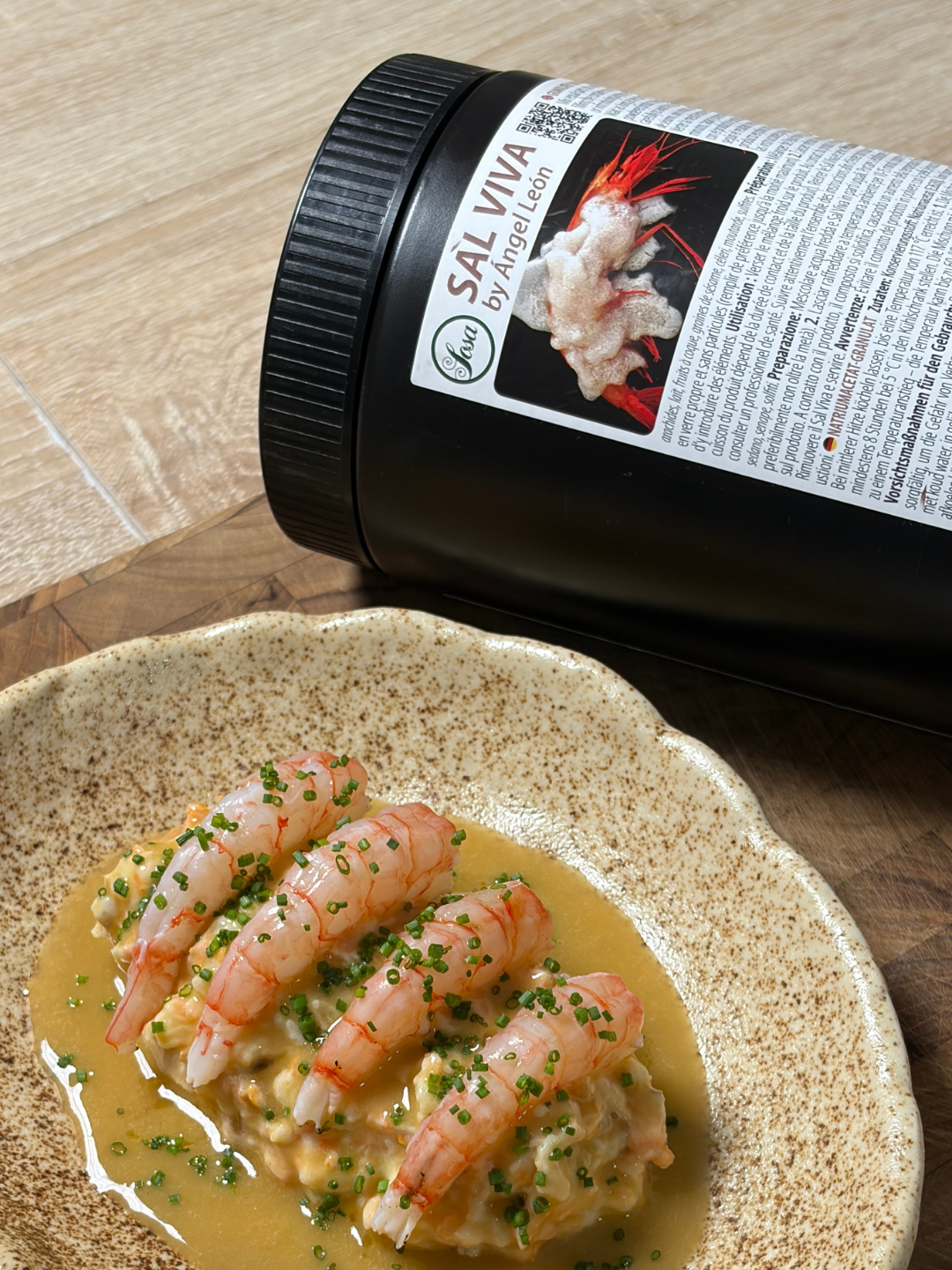
Javier Sánchez, a regular collaborator with Sosa Ingredients, took on that challenge when we asked him to develop a recipe with Living salt. His answer was this Shrimp Ensaladilla in Living salt: a dish that respects the memory of the classic, yet adds a final tableside cooking gesture that is hard to forget.
Living Salt is salt with a particular behaviour: when it comes into contact with water, it triggers an exothermic reaction that generates heat immediately and visibly. What in chemistry is a basic principle becomes, in the kitchen, a spectacular resource: the possibility of finishing a cook in front of the diner, without flame, without a plancha, without equipment.
In this recipe, Javier Sánchez uses it for exactly that. The shrimp in the ensaladilla reach the table at the precise point of pre-cooking, and it is the Living Salt that completes the process before the eyes of the person about to eat them. The steam, the heat that appears out of nowhere, the aroma released at that moment: it is all part of the dish.
It is a resource that transforms the diner’s relationship with what they are eating. The ensaladilla stops being something that arrives finished from the kitchen and becomes something that happens in front of them.
The second axis of the recipe lies in what is normally thrown away.
Javier makes an escabeche with the shrimp heads, concentrating all the marine, iodine-rich, deep flavour that is lost when only the body of the crustacean is used. The heads contain the highest concentration of the shrimp’s juices and aromatic fats, and an escabeche—with its vinegar, its oil and its spices—is the perfect technique to extract and stabilise them.
This escabeche gives the ensaladilla the depth of flavour that sets it apart from any conventional version: it is no longer an ensaladilla with shrimp, it is an ensaladilla of shrimp in every part of it.
An escabeche is, by nature, an unstable preparation. Oil and vinegar tend to separate, and in a dish where that escabeche must integrate homogeneously with the rest of the ensaladilla, that separation is a real technical problem.
Flaxfiber, our flax fibre, resolves that instability. Its water-holding capacity and its behaviour as a stabilising agent allow the escabeche to maintain a homogeneous, bound texture, without syneresis or phase separation, both during preparation and in storage.
What matters technically is that Flaxfiber stabilises without adding its own flavour and without creating heavy or gummy textures. The escabeche retains its fluidity and its aromatic profile intact: the fibre works invisibly, which is exactly what is required of a stabiliser in a preparation with such a pronounced flavour.
The best thing about this Shrimp Ensaladilla in Living Salt is that it remains, unequivocally, an ensaladilla. Javier Sánchez has not deconstructed the dish or turned it into something else. He has kept its identity, its format and its character as a recognisable tapa, and has added two layers: one of flavour, with the head escabeche, and another of experience, with the final cook in Living Salt.
It is exactly the kind of reinterpretation that works at the bar: the diner recognises what they are ordering, but receives something they did not expect.
Autumn has its own calendar in the kitchen, and few ingredients mark it as emphatically as mushrooms. Their season is brief, conditioned by rain and temperature, and during those weeks they become one of the most coveted products in the European pantry. Saffron milk caps, porcini, trumpet mushrooms, chanterelles: each variety brings a distinct nuance […]
There are combinations gastronomy doesn’t need to justify. Porcini and truffle is one of them. Both come from the same territory -the forest floor, the autumn humidity, the soil that surrounds them- and both share that deep, earthy, umami profile that has made them two of the most prized products in European cuisine. But they […]

Some recipes do not need to be complicated to be extraordinary. The chive, garlic, and parsley mayonnaise by Carlos Maestre is exactly that: a sauce with classic roots and recognizable market ingredients, but executed with a technical precision that elevates it above any conventional mayonnaise. And the ingredient that makes it possible is Promayo, our […]



 938 666 094
 sosa@sosa.cat