
 SOSA
SOSA
Leading international company in the creation and distribution of premium ingredients for gastronomy, pastry and modern cuisine, recognised for its innovation in textures, technique and culinary development.
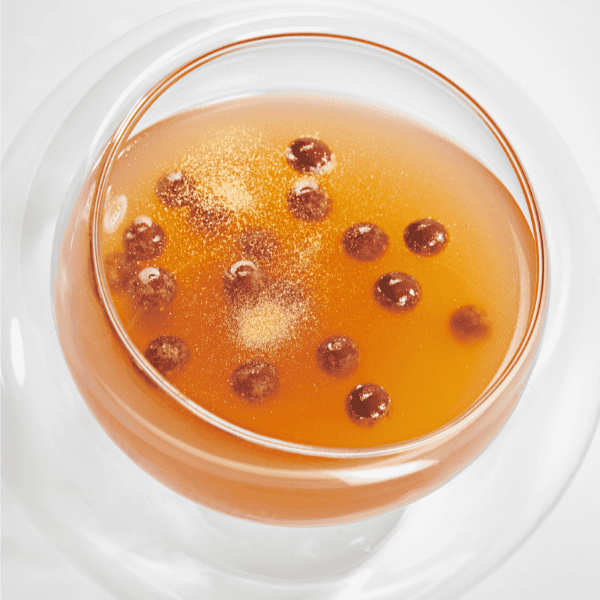
In the constant of surprising presentations in gastronomy, the recipe for Translucent Soup of Grué de cacao represents one of those elaborations that defies the usual and elevates the technical at the service of flavor. This preparation is based on the use of CLEAR XANTHAN GUM, a state-of-the-art thickener that allows texturizing liquids without losing its transparency, which is essential to achieve the unique visual effect of a soup that looks like water… but has an unmistakable aromatic power.
The recipe is based on cocoa gruè, the soul of cocoa before it is transformed into chocolate, which infuses the preparation with deep, bitter and slightly roasted notes. This soup not only provides visual impact, but also a perfect contrast of flavors for creative dishes, from sweet proposals to more savory applications.
The CLEAR XANTHAN GUM allows us to maintain a fluid texture, slightly unctuous, but visually clear. Thus, we achieve that this soup works both as a tasting element, a sauce or a base for a complex dessert. A minimalist recipe in appearance, but full of technique and flavor.
The Sal Viva by Ángel León is food-grade sodium acetate (E262), the salt obtained from the acetic acid in vinegar. Created by Ángel León and his team at Aponiente and marketed in Europe by Sosa Ingredients, it behaves differently from common salt: when cooled carefully, it remains a supersaturated solution, liquid but ready to crystallize. […]
Plated dessert is probably the most demanding discipline in restaurant pastry. Unlike a display-case preparation, which must hold for hours, a plated dessert is built to be eaten at the exact moment it reaches the table. This makes it possible to work with contrasting temperatures, fleeting textures and preparations that would not survive in a […]
Smoking is one of the oldest techniques in cooking and, at the same time, one of the most difficult to integrate into professional service. It requires specific equipment, time, space, and precise control of the process. In a catering context where operational efficiency is as critical as the result on the plate, this technical barrier […]



 938 666 094
 sosa@sosa.cat