
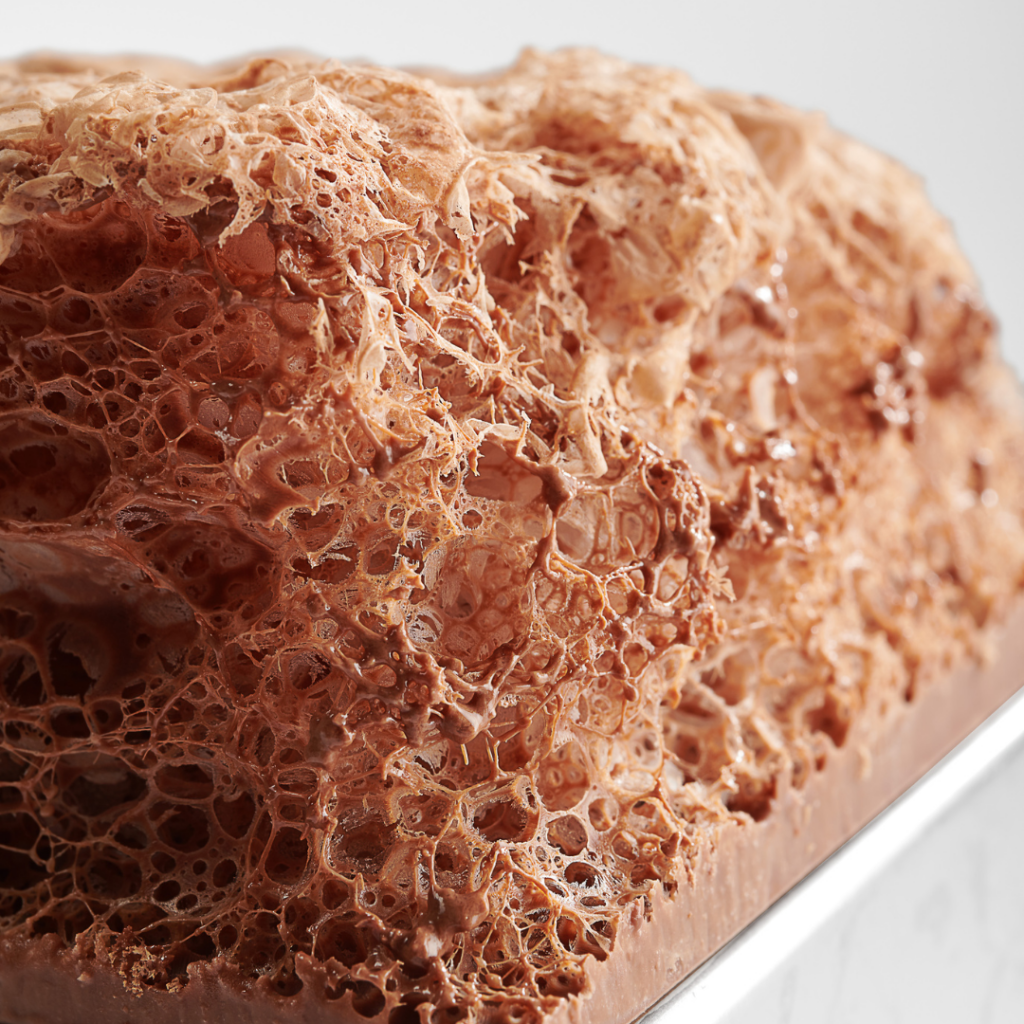
Chocolate foams represent one of the most delicate territories in contemporary pastry. Achieving an airy texture that maintains the aromatic intensity of cocoa, without losing structure or definition, requires a deep understanding of how sugars, fats, and emulsifiers interact. In this recipe, developed by Javier Guillén, we work with Valrhona’s Guanaja 70% chocolate, a grand cru with a distinct character, and apply a precise technique to obtain a stable foam with controlled texture.
Bubble size: a matter of sugar balance
Javier Guillén proposes a fundamental technical premise: “in a foam, the more sugar there is, the larger the bubble will be.” This seemingly simple principle completely determines the final texture of the preparation. An excess of sugar generates large, ill-defined bubbles, resulting in a coarser and less ethereal mouthfeel. Conversely, a controlled formulation allows for fine, creamy, and persistent bubbles.
The technical challenge lies in finding the exact point where the foam maintains its structure without losing lightness. This is where the selection of the emulsifier becomes crucial.
Sucro Emul: superior stability compared to powdered lecithin
In this recipe, we have incorporated Sucro Emul, a high-performance emulsifier that radically transforms the behavior of chocolate foam. Unlike powdered soy lecithin, which is the traditionally most used emulsifier in foams, Sucro Emul offers significantly superior stability both during whipping and subsequent preservation.
Powdered lecithin works, but its emulsifying capacity is limited when working with high-percentage cocoa chocolates, where fat and solids compete for space in the aerated structure. Sucro Emul, on the other hand, acts as a molecular bridge between the fatty phase of the chocolate and the aqueous phase of the base, allowing air bubbles to integrate homogeneously and maintain their volume for longer.
Foam Kit and freezing: setting the aerated structure
The whipping technique requires the use of a Foam Kit, a compressed air system that allows for controlled air incorporation and generates a foam with a homogeneous texture. Unlike a traditional siphon with nitrous oxide, the Foam Kit works exclusively with air, giving us greater control over the density and bubble size.
Once the foam is whipped, the next technical step is key: freezing. Although the recipe as a whole is not freezable—meaning we cannot freeze the final dessert—we can freeze the freshly whipped foam to set its structure. This rapid freezing process solidifies the bubbles, allowing the foam to maintain its shape and texture even when returned to serving temperature.




 938 666 094
 sosa@sosa.cat