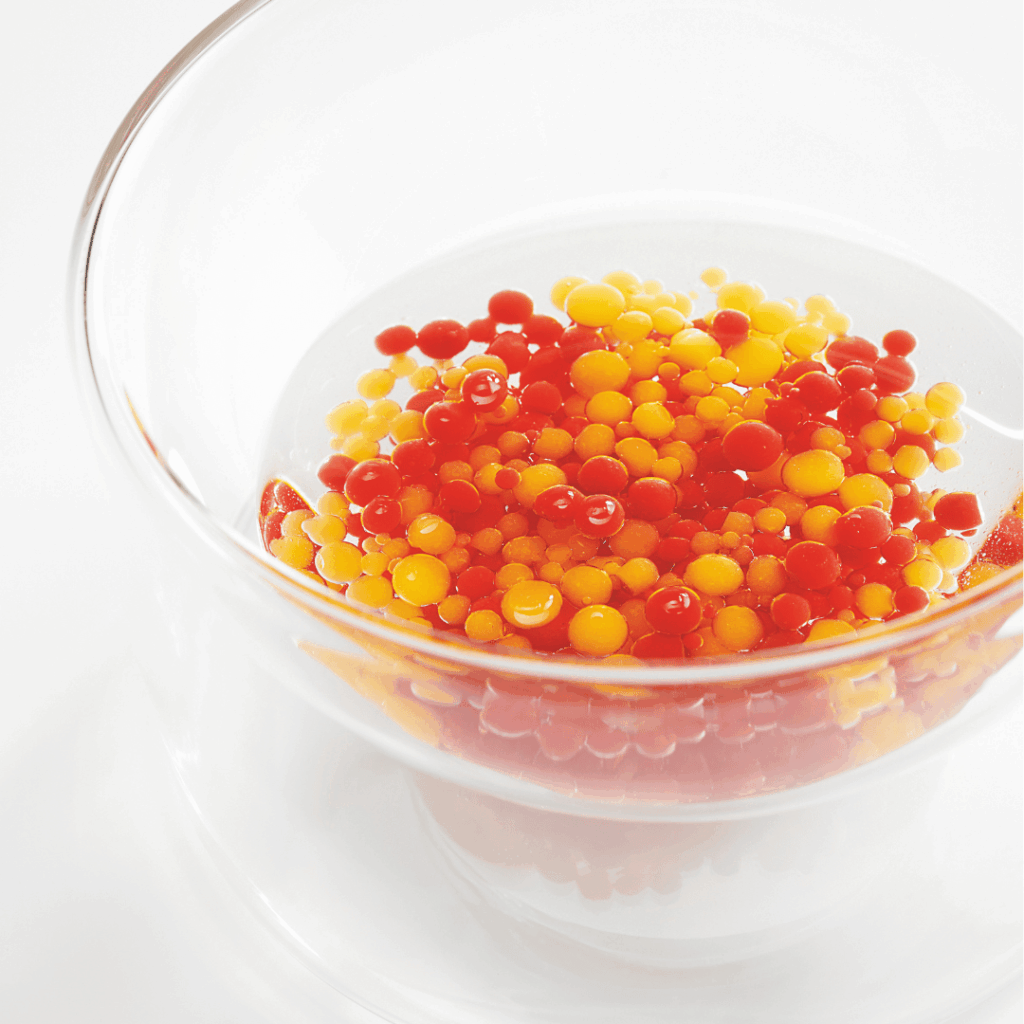
The spherification technique has revolutionized the way chefs and pastry chefs interpret flavors. This time, we present Fruit Caviar, a visually stunning and simple recipe made with the gelling agent Agar-Agar.

For this recipe, we have developed two variations of fruit caviar, adapted to the profile of each ingredient. In the case of sweet fruits—such as mango, strawberry, or peach—the balance is easily achieved thanks to their neutral pH and natural sugar content.
However, for acidic fruits, such as passion fruit, raspberry, or lemon, pH control is key. By adjusting the acidity, we ensure that the agar-agar gelation remains stable, guaranteeing the perfect shape of each sphere and a clean, delicate texture.

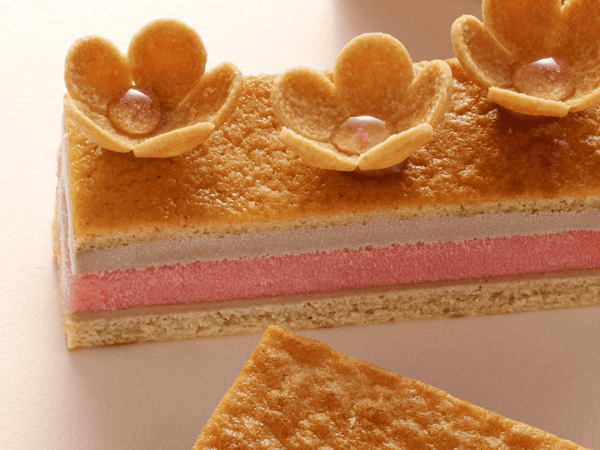
Fruit caviar can be used as a decorative or contrasting element in desserts, cocktails, tarts, savory dishes, or even in molecular gastronomy. Its versatility allows you to add a touch of modernity and technique to any creation, without sacrificing the authentic flavor of the fruit.
Fruit Caviar

Ingredients

Prepared by

  • Sweet fruit caviar

    1. Bring to a boil the water, pulp, sugar, Agar-Agar and the water-soaked gelatin.
    2. Stir occasionally and wait until the temperature drops to 50°C. Caution: Do not cool on ice.
    3. In a tall, narrow tube filled with ice-cold oil, drop the fruit mixture into the ice-cold oil using a pipette.
    4. Pass through a chinois strainer, wash the pearls in ice water and store them in the refrigerator.
    5. Note: This recipe works with lychee, mandarin orange, fig, watermelon, papaya, pear, apple, cherry, banana, and mango. Fruits with a pH between 3.2 and 5.
  • Caviar made from sour fruits

    1. Bring to a boil the water, pulp, sugar, Agar-Agar and the water-soaked gelatin.
    2. Stir occasionally and wait until the temperature drops to 50°C. Caution: Do not cool on ice.
    3. In a tall, narrow tube filled with ice-cold oil, drop the fruit mixture into the ice-cold oil using a pipette.
    4. Pass through a chinois strainer, wash the pearls in ice water and store them in the refrigerator.
    5. Note: This recipe works with Apricot, Lemon, Lime, Blueberry, Currant, Passion Fruit, Kiwi. Fruits with a pH below 3.2.

Share this recipe

Other recipes that may interest you