
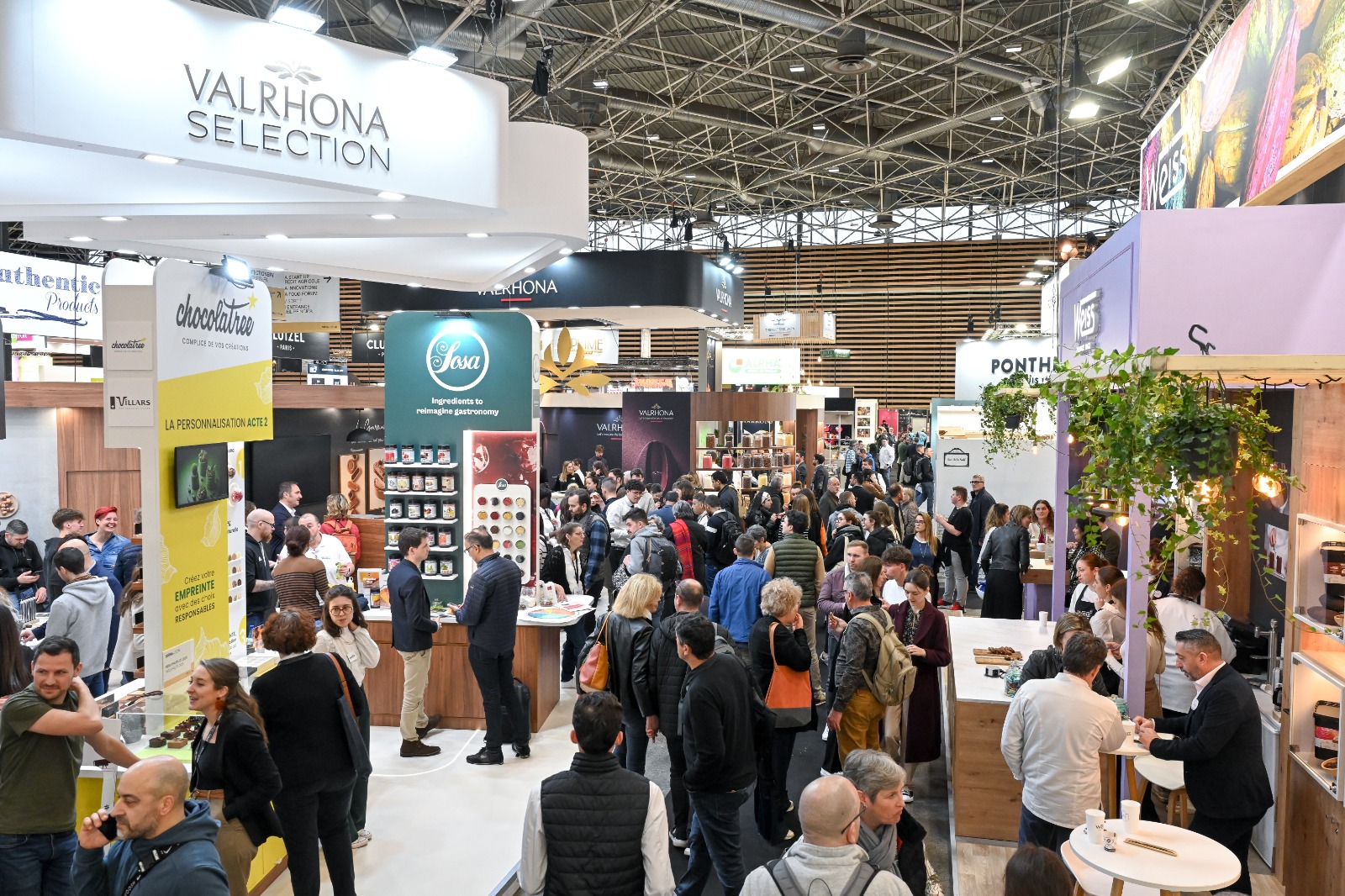
Every two years, in January, the city of Lyon becomes the world capital of professional gastronomy. For five days, a 140,000 m² venue brings together producers, manufacturers, distributors, chefs, pastry chefs, ice cream makers, buyers and specialist press from across the planet. This is Sirha Lyon, and it is where the industry takes its own pulse.
For us it is not just another trade fair. We have taken part for several editions because we see Sirha as the largest showcase in premium food service today: the point where product innovation, high-level technique and the world’s most demanding culinary competitions all converge.
In this article we explain exactly what Sirha is, how the two major competitions it hosts work (the Coupe du Monde de la Pâtisserie and the Bocuse d’Or), how the teams that reach Lyon are selected, and why this event matters so much to an ingredients house like ours.
What Sirha Lyon is
Sirha Lyon is the International Hotel, Catering and Food Trade Exhibition. It is held at Eurexpo Lyon and has been organised by GL events and Sirha Food since 1984.
It runs on a two-year cycle: every other year it gathers the most influential players in global food service for five days, organised by business universe (gourmet, bakery and pastry, kitchen equipment, food products, tableware). Around that sit demonstration stages, masterclasses, the Sirha Innovation Awards and the great international competitions.
Sirha Lyon 2025, in figures:
- More than 257,000 qualified professionals
- 2,300 exhibitors and 4,700 brands
- 800 innovations and new products presented
- 140,000 m² of floor space at Eurexpo
The next edition runs from 21 to 25 January 2027 at Eurexpo Lyon, with access reserved for trade professionals.
The show also publishes the Sirha Dynamics, a trend analysis developed with the consultancy Loeb Innovation that decodes shifts in consumption, new restaurant formats and the sector’s environmental and health challenges. It is one of the most closely followed market readings in the industry.
Why Sirha matters to us
We work with professional chefs, pastry chefs and ice cream makers in more than 70 countries. Our product cannot be explained on a shelf: it is explained in the hands of the person using it, in a texture that holds, in an ice cream that survives the display cabinet, in a flavour that does not get lost along the way.
That is why Sirha is a natural space for a house like ours:
- It is the market, concentrated. International buyers, distributors and decision-makers from major groups in the same place, in the same week.
- It is the technical barometer. What is shown in Lyon in January shapes much of the industry’s conversation for the following two years.
- It is where the elite competes. The two most demanding competitions in the world take place there, and working alongside those teams is the best way to put our ingredients through the hardest possible test.
That last point explains our link with the Coupe du Monde de la Pâtisserie, of which we are an official partner and in whose qualifying rounds we have been taking part as sponsors.

The Coupe du Monde de la Pâtisserie: the World Cup of the sweet trades

What it is and where it comes from
The Coupe du Monde de la Pâtisserie (CMP) was created in Lyon in 1989, with the support of the International Union of Bakers, Confectioners, Ice Cream Makers and Caterers, within the show that would later become Sirha. Its founding president was Gabriel Paillasson; since 2019 it has been chaired by Pierre Hermé, with Frédéric Cassel as vice-president.
Its defining feature is the format: each country competes with a team of three specialists, a pastry chef, a chocolatier and an ice cream maker, who work in parallel and are judged as a unit. This is not an individual competition dressed up as a team event. Coordination between the three is, quite literally, part of the score.
Across more than 35 years, the CMP has worked as a career springboard: Pierre Marcolini took the title in 1995 before launching his own house, and Christophe Michalak won in 2005 before becoming one of the best-known pastry chefs of his generation.
How teams are selected, and how long it takes
The road to Lyon is a two-year cycle structured in three stages:
| STAGE | WHEN | WHAT HAPPENS |
|---|---|---|
| National selections | Odd years (2025 for the current cycle) | Each participating country runs its own selection to appoint the team that will represent it. There are more than 50 national selections on the circuit. |
| Continental selections | The following year (2026) | Five continental heats: Europe, the Americas, Asia-Pacific, Africa and, since 2026, the Middle East. They determine which countries qualify. |
| Gran Final | January of the following odd year (2027) | Between 18 and 20 countries compete at Eurexpo Lyon, within Sirha. |
The 2027 Grand Final takes place on 22 and 23 January in Lyon.
One detail that captures the level of demand: a team reaching the final has two years of competition behind it, and usually many more months of training before its own national selection. The organisation also appoints International Ambassadors by continent (for a maximum of four years, or two cycles) who support the teams throughout the journey and help run the continental heats.
The Grand Final events
In the 2027 edition, teams face three disciplines split across several events, with a total of nine hours of competition:
Tasting:
- Plated frozen dessert: 15 individual desserts plated to order in a restaurant spirit, based on a free reinterpretation of the vacherin.
- Saint-Honoré: 3 pieces for 6 people each, built on a classic assembly and incorporating a local product or national speciality.
- Chocolate Show: 30 staged sweet creations in a finger-food format, on the theme Heritage and Cultures.
Artistic:
- Artistic sugar piece, produced entirely on site.
- Artistic chocolate piece, focused on the chocolatier’s handwork.
- Water ice sculpture: 1h30 from a single block.
Final buffet:
The three artistic pieces must merge into a single work on a one-metre-by-one-metre table, with the desserts integrated in visual contact with the sculptures.
How it is scored
The international jury assesses far more than technique. In tasting, it looks at the balance of flavours, textures and temperatures, the elegance of the product and the emotion it provokes. On the artistic side, technical mastery, clean assembly, elegance and the coherence of the buffet.
For several editions there has also been a responsible commitment assessment, evaluated across the nine hours of competition on four fronts: zero food waste, no single-use containers, direct sourcing from producers and reasoned use of consumables.
The roll of honour
France dominates the history of the competition with 8 titles. Japan, winner of the last two Grand Finals (2023 and 2025), is the leading nation of the moment.
Spain 2011: the victory of Jordi Bordas and Julien Álvarez
In January 2011, at the twelfth edition of the Coupe du Monde de la Pâtisserie, Spain won for the first time.
The team was made up of Jordi Bordas, Julien Álvarez and Josep Maria Rodríguez, with Yann Duytsche leading the team. They competed against 19 countries and took gold ahead of Italy (silver) and Belgium (bronze). Their work was inspired by Jules Verne’s Around the World in Eighty Days: Julien Álvarez’s sugar piece recreated the race against the clock, while the chocolate locomotive referenced Phileas Fogg’s journey.
That victory changed the international perception of Spanish pastry and opened up careers that are now world references. Jordi Bordas went on to develop his own formulation method and his school; Julien Álvarez has built a career in high-end French and international pastry and today sits on the International Organising Committee of the Coupe du Monde de la Pâtisserie.
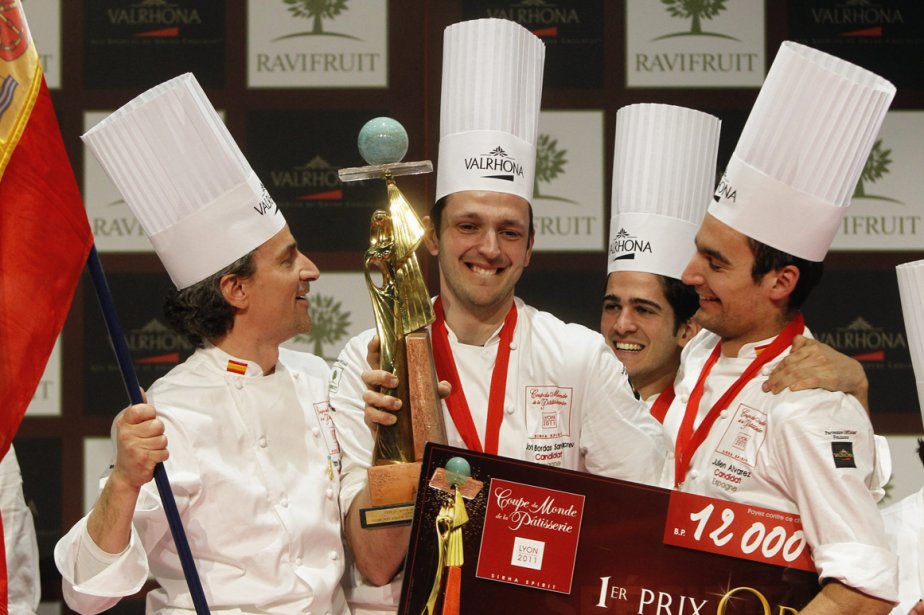
Both are now ambassadors for Sosa Ingredients, and that relationship is no accident: they are professionals who work from technique, formulation and a deep understanding of the ingredient. Exactly the ground we operate on.
Spain, back in the competition
After fifteen years away, Spain returned to the CMP European Selection in January 2026, held as part of Sirha Bake & Snack in Paris. The team was made up of Marcos Díaz (captain, chocolate), Albert Soler (ice cream) and Toni Pons (sugar), with Jordi Guillem as team delegate. We supported them as premium sponsors of that selection.
France won the heat, with Belgium and Italy completing the podium.
The Bocuse d’Or: the most demanding culinary competition in the world
Origin and meaning
The Bocuse d’Or was created by Paul Bocuse in 1987, also in Lyon, around an idea that was revolutionary at the time: to take cooking competitions out of closed rooms and turn them into a live contest, in front of an audience, cameras and an international jury, with the format and tension of a major sporting event.
Almost forty years later it remains the most prestigious individual culinary competition on the planet. The 2027 edition will mark its 40th anniversary, on 24 and 25 January at Sirha Lyon.
In countries with a strongly institutionalised culinary culture, the Bocuse d’Or functions almost like a national team. France, Norway, Denmark, Sweden and Japan maintain academies, sponsorship programmes and stable training structures between editions. The 2025 podium illustrates this well: gold for France (Paul Marcon), silver for Denmark and bronze for Sweden. For a chef, winning the Bocuse d’Or is not just another prize: it marks a before and after in their career and in the visibility of their country’s cuisine.

How selection works: more than two years of competition
The qualification system mobilises more than 72 countries and unfolds over more than two years:
- National selections Each country holds its own selection, run by its national academy under the supervision of the International Organising Committee. There are more than 70 national selections worldwide. The system of national and then continental pre-selections has been in place since 2005.
- Continental selections Five heats: Europe, the Americas, Africa, Asia-Pacific and the Middle East (the latter added in 2026). In practice, these are finals in their own right.
- Grand Final in Lyon. 24 teams reach the final, with places allocated as follows: 10 for Europe, 5 for the Americas, 5 for Asia-Pacific, 2 for Africa and 1 for the Middle East. The organisation also reserves the right to award a wild card per selection.
For the 2027 cycle, the Bocuse d’Or Europe was held in March 2026 in Marseille, as part of Sirha Méditerranée, with 20 teams competing for the 10 European places. Denmark won, followed by Norway and Italy.
The events and the training
Since 1987 the competition has revolved around two legendary events:
- Platter theme (Plateau): the historic signature of the Bocuse d’Or. A spectacular, extremely technical presentation conceived as a tribute to the art of French gastronomic service. It tests cutting, cooking, garnishes and precision.
- Plate theme (Assiette): introduced to reflect the real practice of contemporary fine dining. It rewards à la minute plating, visual finesse and balance of flavour.
Two days of competition and 5 hours 30 minutes of execution to deliver the themes.
Behind those five and a half hours there are, in most cases, months or even years of preparation. The candidate does not compete alone: they work with a commis (a young assistant, with a dedicated prize at the final) and a coach, and usually with a whole support team, sponsors and a national academy behind them. Training means running the full test again and again, against the clock, adjusting weights, timings, movements and kitchen logistics until any margin for error is eliminated. Resistance to pressure is trained as hard as technique.
The Executive Committee, chaired since 2024 by Davy Tissot (winner in 2021), oversees the rules, the continental heats and the Grand Final. Its members include former winners such as Mathew Peters and Geir Skeie, Meilleurs Ouvriers de France and chefs including Anne-Sophie Pic.
The Lyon 2027 calendar
| Date | Event |
|---|---|
| 21 – 25 January 2027 | Sirha Lyon, Eurexpo (trade access only) |
| 22 – 23 January 2027 | Grand Final of the Coupe du Monde de la Pâtisserie |
| 24 – 25 January 2027 | Grand Final of the Bocuse d’Or (40th anniversary) |
Our commitment
Supporting these competitions is not a visibility exercise for us. It is consistent with what we do: developing technical ingredients that allow professionals to get exactly where they want to go, with precision and without giving up flavour.
We are an official partner of the Coupe du Monde de la Pâtisserie, we supported the 2026 European Selection as premium sponsors and took part in the French team’s qualifying round, and we are backing the Spanish team on its return to the competition. And we work with ambassadors such as Jordi Bordas and who know from the inside what it means to compete at the highest level.
See you in Lyon.


 938 666 094
 sosa@sosa.cat