
Sal Viva: the salt that cooks at the table
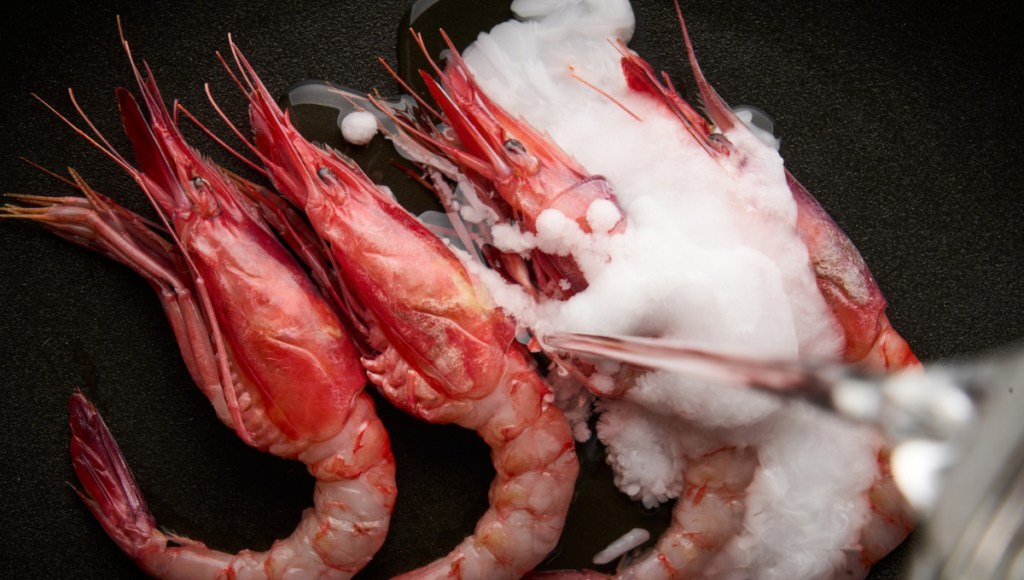
A transparent brine falls over a prawn and, within two seconds, turns into a white block that releases heat. No fire, no electricity — just salt. This is Sal Viva, the technique created by Ángel León and his team at Aponiente (three Michelin stars), which Sosa Ingredients makes available to professional kitchens.
Here is what lies behind it, how it works and how to make the most of it.
What is sodium acetate?
Sal Viva is sodium acetate: the salt derived from the acetic acid in vinegar.
Although the name may sound like something from a laboratory, you have tasted it many times — it is the ingredient that gives salt-and-vinegar crisps their flavour without making them soggy, and the food industry has been using it for decades to regulate acidity and preserve breads, sauces and pickles. On the label it appears as E262.
On the palate it delivers a saline taste with a very mild acidic nuance. But in avant-garde cuisine, it is valued above all for a remarkable physical behaviour.
The secret: “hot ice”
Sodium acetate dissolves in hot water in far greater quantities than common salt. If that solution is cooled carefully, it becomes supersaturated: still liquid, but “loaded” with salt that wants to return to crystal form.
All it takes is a small trigger — contact with a food — for it to crystallise all at once. In doing so, it releases heat. That is why it is called “hot ice”: it looks like ice, but it warms.
Ángel León’s technique
Ángel León, the Chef of the Sea, turned this phenomenon into a way of cooking. When the cold Sal Viva is poured over a seafood product, a crystalline crust forms around it and raises its temperature to around 60 ºC — enough to temper or briefly cook small, delicate pieces.
An ally for showcooking and presentation
Sal Viva turns service into a spectacle. The final step takes place in front of the guest: the front-of-house team pours the solution and, within seconds, the transparent liquid transforms into a white block that envelops the product and heats it without fire or electricity.
It is an ideal resource for showcookings, demonstrations and tasting menus: the guest not only tastes the dish but witnesses how it is finished. It works particularly well with prawns, barnacles or tartares, where the crystallisation evokes the essence of the sea and reinforces the bond between technique and emotion.
How to use Sal Viva, step by step
The technique harnesses the potential of Sal Viva in short cooking times and small pieces, allowing for a sophisticated and technical presentation.
Prepare the solution:
- Bring water or a flavoured liquid to a boil.
- Add the Sal Viva and stir until completely dissolved.
- Boil until it reaches 117 ºC.
Cool without touching:
- Slowly pour into a clean container of tempered glass or stainless steel.
- Make sure the container is clean and free of impurities or sharp edges, as they could spontaneously activate recrystallization.
- Leave to cool below 20 ºC (ideally 5 ºC) without moving the container or placing anything inside it.
Protect yourself:
- During preparation and handling, always use approved hand and face protection. The exothermic reaction can generate splashes or hot steam.
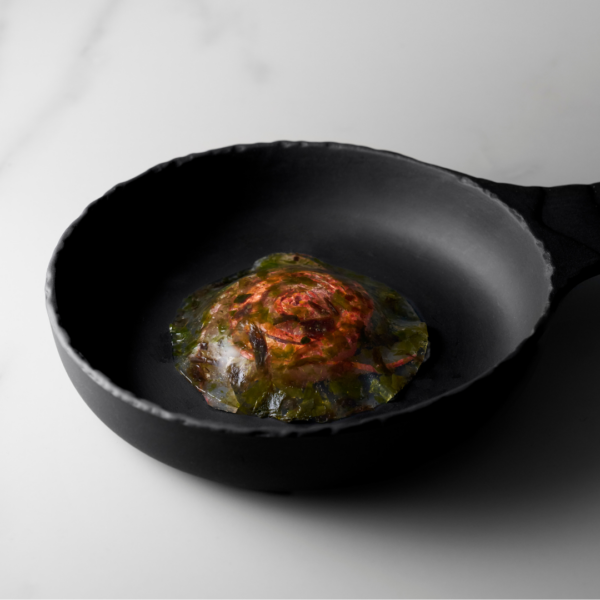
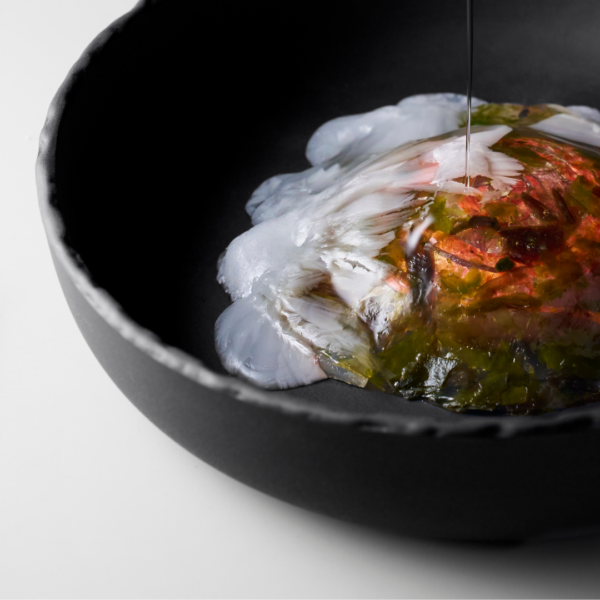
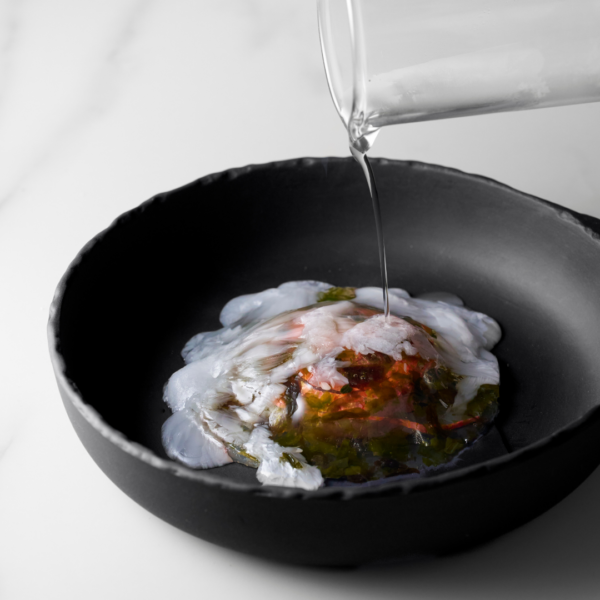
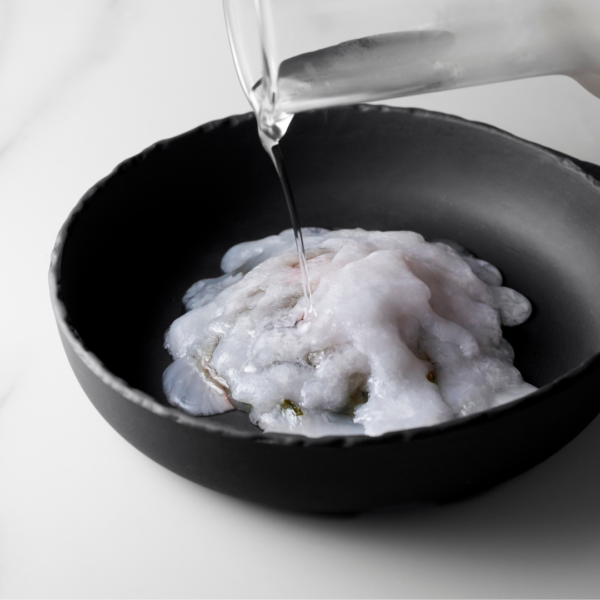
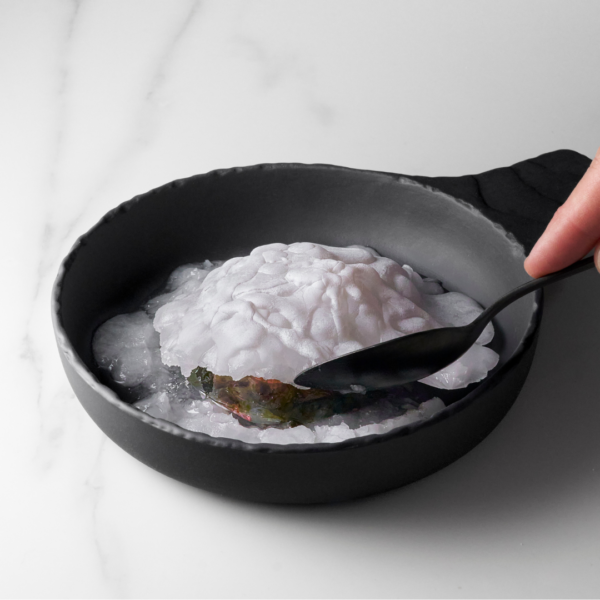
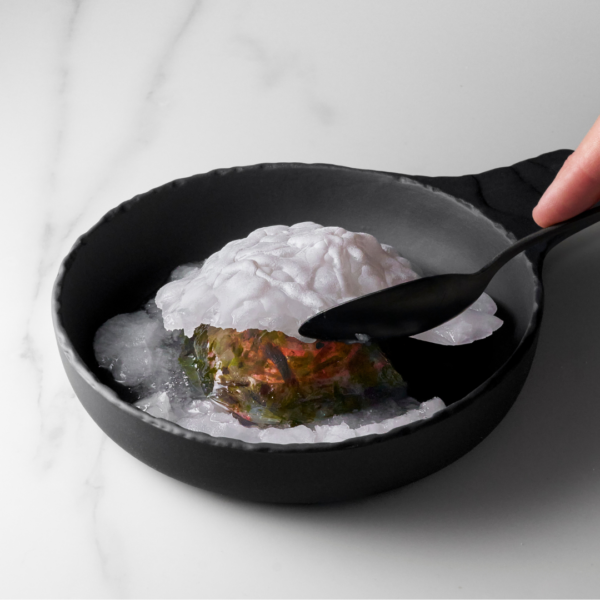
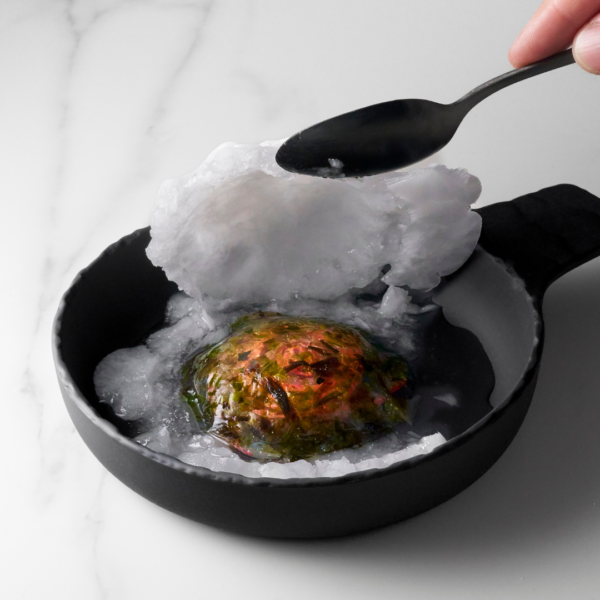
Apply to the product:
- Once the mixture is completely cold, pour it slowly over the product you want to temper.
- Upon contact with the food, the mixture activates, crystallizing instantly and generating an exothermic reaction that raises the temperature up to 60ºC (may vary slightly depending on the saturation, the container, or the size of the food).
- The temperature gradually decreases, allowing the cooking time to be extended if necessary for small or delicate pieces.
Cooking tips
- If it crystallises too early, it is almost always due to an impurity, a scratch in the container or a sudden movement. Reheat until dissolved and repeat.
- Think small: it works best with small or thin pieces and short cooking times.
- Play with the base liquid: a broth, filtered seawater or an infusion adds a flavour nuance to the crust.
- Remove the crust before eating: it comes off as an easy-to-separate block; the product retains a saline-acidic touch.
Application ideas:
Barnacles, prawns, carabinero shrimp, tartares and tuna belly are the most natural uses. But the technique invites exploration: tender vegetables, dairy products or even sweet preparations where the saline-acidic contrast makes sense.
A unique ally for staging seafood products
Sal Viva not only facilitates cooking, but turns each dish into a spectacle. It is perfect for foods such as prawns or tartares, where crystallization provides a unique texture and flavor.
Its ability to interact directly in front of the diner reinforces the link between gastronomy and emotion, evoking the essence of the sea in each presentation.
Distributed by Sosa Ingredients across Europe
Sal Viva, created by Ángel León and his team at Aponiente, is distributed across Europe by Sosa Ingredients, specialists in premium ingredients for professional gastronomy and patisserie. A tool for chefs looking to surprise with advanced techniques and high-impact presentations, with consistent results at every service.




 938 666 094
 sosa@sosa.cat