
Knowing the different types of dietary fiber allows us to make the best creations in pastry, combining the greatest success of flavor and texture. Fibers are, without a doubt, one of the most innovative options when it comes to finding gastronomic solutions for the elaboration of modern recipes. The existing dietary fibers allow us to make the best creations in pastry, combining the greatest success of flavor and texture.
Dietary Fibers in Pastry
Why are fibers in pastry important? This discipline requires various technical functions to achieve a healthier and lighter texture, as well as a pure flavor, without an excessive presence of elements such as sugar.
Achieving the best quality elaborations currently involves the use of dietary fibers that replace traditional base ingredients (such as butter) when carrying out their functions within the recipe.
Functions of Fibers in Pastry
Depending on the characteristics of dietary fibers, they can perform the following functions in pastry:
- Thicken. That is, give body to a liquid preparation, such as a sauce or cream.
- Provide elasticity to ensure that a dough stretches and does not break.
- Bind or compact a dough. Likewise, this name is given to the process that allows the various ingredients to be joined together.
- Emulsify. This function involves making a homogeneous mixture of water and fatty elements.
- Stabilize. In other words, this is the process that helps maintain the appearance and texture of a pastry preparation, both in its conservation and in its freezing and thawing.
- Provide a fatty sensation. Fat is a fundamental element in pastry, because it provides creaminess and texture to any preparation. In addition, they provide flavor.
- Provide solids, which structure and give creaminess to the dish. In addition, some of them play an important role in the substitution of sugars.
Types of Dietary Fibers
The list of fibers we work with includes the following:
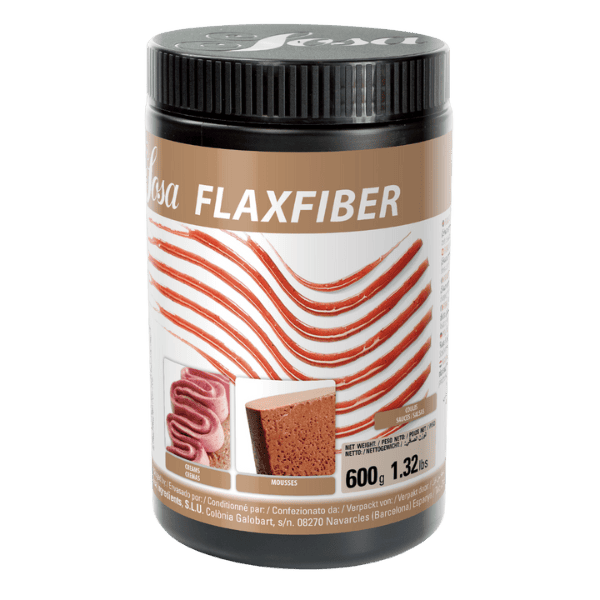
Flaxfiber
Made with the mucilage that is extracted from flax seeds, so it is totally of vegetable origin. It has thickening, stabilizing and emulsifying properties.
One of its great advantages is that its flavor is neutral. In addition, it is transparent, so it does not affect the color of the preparations.
It is also worth noting its easy dissolution, even without bringing it to the heat. Among its applications, sauces, coulis, mousses and meringue stand out. It is also a binder in doughs and cookies.
Natur Emul
Extracted essentially from the skin of citrus fruits, it is an excellent emulsifier both in cold and hot preparations. It should also be noted that it is soluble in water and fatty elements, with different pH.
This dietary fiber is used in creams, sauces, whipped doughs and ice creams.
Psyllium
This fiber is also completely vegetable, since it originates in the shell of a plant called Plantago ovata. It can be used to replace gluten in fermented doughs, including those with low hydration and those that are very elastic.
Among its characteristics, the capacity to absorb liquids and the stability in preparations of different temperatures and pH stand out.
Inulin hot
It comes from various roots and tubers, and it must be taken into account that it is mixed in liquids, always at a hot temperature and stirring strongly.
It is characterized by providing a fatty sensation, lightening the preparation. Therefore, it makes it much more pleasant to taste. In addition, the texture is maintained if the product is frozen and thawed. Finally, it should be noted that it is neutral in taste and smell.
Cold inulin
This fiber is also extracted from roots and tubers. It can be applied in cold and hot liquids, as long as it is stirred vigorously.
It provides creaminess to the texture, replacing base solids such as sugars. Its application is common in mousses, ice creams, creams, ganaches, meringues and sorbets. In the latter, it has the advantage of dissolving easily, respecting the flavor of the fruits.
What are the differences between cold and hot inulin? As we have seen, there are many similarities between both fibers, but we must take into account that the cold one has 90% fiber and 10% sugars. On the other hand, the one that dissolves in heat is made up of 99% fiber. It should also be noted that the latter serves to provide more fatty sensation than the former.
Oligofructose
This is a completely vegetable fiber, since it is found in different roots and tubers. It is very soluble and dissolves easily both cold and hot, with only a slight agitation to the preparation. It also does not add color or flavor to any preparation and works, even, in acidic preparations. In addition, it maintains the texture when the preparation is frozen and thawed.
This fiber is intended to replace, even completely, sugars. In this way, it improves the nutritional value of a recipe and enhances the flavor of the rest of the ingredients, reducing the sensation of sweetness.
It is applied in all types of sweet preparations, such as ice creams, mousses or sponge cakes.
Definitely, the different types of dietary fiber are a great contribution to modern pastry. If you want to have more information, you can download the Fiber Use Manual in the following link.





 938 666 094
 sosa@sosa.cat